
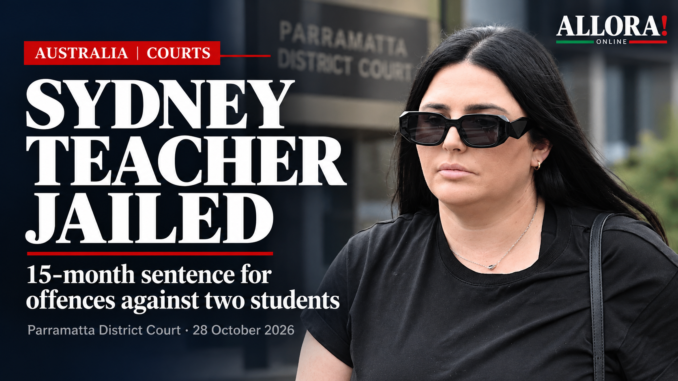
Former high school teacher Tayla Lee Brailey has been sentenced to 15 months in prison after admitting to sexual offences involving two students aged 16 and 17. A NSW judge condemned the abuse of trust and authority, while one victim described the devastating impact on his education and personal life.
A former Sydney high school teacher has been sentenced to 15 months in prison after sexually abusing two teenage students under her care, with a judge finding that her conduct represented a serious breach of the trust placed in educators.
Tayla Lee Brailey, 32, appeared before Parramatta District Court on Wednesday, October 28, after pleading guilty to offences involving two male students, aged 16 and 17, as well as offences involving child abuse material.
The court heard that Brailey had sexual intercourse with the older student and sexually touched the younger teenager in a separate incident.
Judge Elizabeth Ryan ruled that imprisonment was necessary, emphasising the responsibility teachers have to protect students and maintain appropriate professional boundaries.
The sentence concludes a criminal prosecution that began following Brailey’s arrest at a south-west Sydney school in August 2024.
Sexual offences involving students under her care
The court heard that Brailey had established contact with the teenagers through social media while working as a teacher.
In one case, she contacted a 17-year-old student through Snapchat and exchanged inappropriate messages before the relationship developed into sexual activity.
According to evidence presented during sentencing, the pair subsequently met during a school day and had sexual intercourse in the teenager’s vehicle.
In a separate case, Brailey communicated with a 16-year-old student through social media before sexually touching him inside a classroom.
The offences occurred while both teenagers were under her care, placing her in a position of authority and responsibility.
Under NSW law, a teacher’s position of special care creates specific legal protections for young people, including those who are above the general age of consent.
The offences were therefore not simply a matter of an inappropriate relationship. They involved the unlawful exploitation of a teacher’s authority over students.
Brailey also admitted offences relating to the use of electronic communications to access and transmit child abuse material.
One student’s education and personal life severely affected
The sentencing hearing revealed the significant emotional consequences experienced by one of the teenagers.
In a victim impact statement presented to the court, the younger student described feelings of shame, distress and self-blame following the abuse.
He said the experience had affected his relationships with friends and contributed to his decision to leave high school before completing Year 12.
The court also heard that he experienced disturbed sleep and intrusive memories of what had happened.
His statement demonstrated the lasting impact that abuse by a trusted adult can have on a young person’s confidence, education and wellbeing.
The fact that a victim experiences self-blame does not transfer responsibility for the offending. That responsibility rests with the adult who abused the position of trust.
The identities of both students and the school involved remain protected by legal restrictions.
Judge condemns breach of trust
Judge Elizabeth Ryan placed particular emphasis on the professional responsibilities breached by Brailey.
The court found that the former teacher knew her conduct was wrong and had taken steps to prevent it from being discovered.
The judge also considered evidence that Brailey had continued pursuing contact with a student despite indications of reluctance.
In sentencing, Ryan emphasised that offences of this nature undermine the relationship of trust between students, families and the education system.
The court determined that a prison sentence was necessary to reflect the seriousness of the offending.
The decision also recognised the broader responsibility of schools and teachers to ensure that students can learn in environments free from exploitation and abuse.
Mental health considered during sentencing
The court heard evidence concerning Brailey’s mental health at the time of the offences.
A psychological assessment indicated that she was experiencing symptoms consistent with a manic episode associated with previously undiagnosed bipolar disorder.
The judge considered this evidence, along with Brailey’s expressions of remorse and personal circumstances, when determining the sentence.
However, the court also concluded that Brailey had understood her behaviour was wrong and had attempted to conceal it.
The mental health evidence was considered as part of the individual sentencing assessment; it did not remove her legal responsibility for the offences.
The court also heard that Brailey had suffered significant personal consequences, including the loss of her employment and damage to family relationships.
Arrests and guilty pleas
Brailey was initially arrested in August 2024 following an investigation into reports of inappropriate sexual conduct involving a student.
She was granted conditional bail but was arrested again less than two weeks later in connection with offences involving another teenager.
The criminal proceedings continued through 2025 and into 2026 before she entered guilty pleas.
The prosecution involved sexual offences against students under special care and offences associated with electronic communications and child abuse material.
The case ultimately proceeded to sentencing in Parramatta District Court.
Fifteen months in prison and child protection registration
Brailey has been sentenced to 15 months’ imprisonment.
She will become eligible for parole on April 24, 2027, although eligibility does not mean that release will necessarily occur on that date.
Judge Ryan also ordered that Brailey be placed on the NSW Police child protection register for 15 years.
Registration imposes continuing reporting and compliance obligations under the applicable legislation.
The court’s decision reflects the seriousness of offences committed by adults occupying positions of authority over children and young people.
A reminder of the responsibility placed on educators
The case raises important questions about professional boundaries, student protection and the responsibility of adults working in schools.
Teachers occupy positions of considerable influence over young people. Students and parents must be able to trust that this authority will be exercised responsibly.
The use of social media to establish private relationships with students can create additional risks when appropriate professional boundaries are not maintained.
Schools therefore have an important role in ensuring that safeguarding policies, reporting arrangements and staff conduct standards are consistently enforced.
For the students involved in this case, the consequences extend far beyond the criminal proceedings.
Their experiences underscore why concerns about inappropriate conduct must be taken seriously and why safeguarding responsibilities must remain central to educational practice.
The Parramatta District Court’s sentence reinforces a fundamental principle: teachers are entrusted with protecting young people, and the abuse of that trust carries serious legal consequences.
ALLORA! ONLINE | AUSTRALIA – CRIME & JUSTICE
By the ALLORA! ONLINE News Desk
Sources: ABC News, Australian Associated Press and court reporting from Parramatta District Court.
The names and identifying details of the students and their school have been withheld in accordance with legal reporting restrictions.


