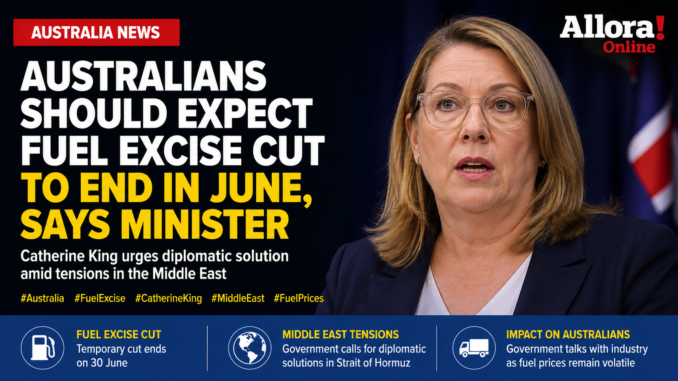
Government monitoring Middle East tensions as fuel price concerns grow
Australians should expect the temporary fuel excise reduction to come to an end at the conclusion of June, despite growing concerns over rising fuel prices linked to renewed tensions in the Middle East.
Federal Transport Minister Catherine King confirmed the government’s position during an interview with ABC News Breakfast, where she addressed the potential economic impact of instability around the strategically important Strait of Hormuz.
The waterway, through which a significant portion of the world’s oil supply passes, has once again become a focal point of international concern amid escalating regional tensions and uncertainty surrounding a fragile ceasefire.
Government calls for diplomatic solution
King stressed that Australia continues to support diplomatic efforts aimed at preventing further escalation in the region.
“Obviously we know that we need diplomatic solutions to the conflict in the Strait of Hormuz, and we want to urge all parties to continue to negotiate that,” she said.
The minister acknowledged the delicate nature of the current situation, noting that recent developments demonstrate just how fragile the ceasefire remains.
“I understand this is a pretty fragile ceasefire, and you’re seeing that borne out, unfortunately, this morning,” King added.
Fuel excise relief likely to end
When questioned about whether the government would extend the fuel excise cut beyond June, King indicated that no extension is currently planned.
The temporary measure was introduced to help households and businesses cope with rising living costs and high fuel prices. However, despite continuing volatility in global energy markets, Australians should prepare for the discount to be removed.
“People should, at this stage, expect that it’s coming off at the end of June,” she said.
Talks continue with industry
The government is continuing discussions with key industries, including the trucking and transport sectors, which are particularly vulnerable to fluctuations in fuel costs.
King said Canberra remains focused on reducing the impact of international instability on Australian consumers and businesses.
“Obviously we are doing everything we can to shield Australians from this conflict in the Middle East,” she said.
Nevertheless, the government faces increasing pressure as fuel prices remain sensitive to geopolitical developments, especially any disruption to shipping routes through the Gulf region.
Cost-of-living concerns remain
The end of the fuel excise reduction could place additional pressure on household budgets already affected by inflation, housing costs, and higher interest rates.
Industry groups have warned that sustained increases in fuel prices may also flow through to freight costs, food prices, and broader supply chains across Australia.
With only weeks remaining before the excise cut expires, motorists and businesses will be closely watching both government policy decisions and developments in the Middle East.
As tensions continue to evolve, the Albanese government appears committed to a diplomatic approach internationally while preparing Australians for the return of the full fuel excise at the end of June.