Africa is once again confronting one of the deadliest and most feared viruses on the planet. Ebola has resurfaced with alarming force in the Democratic Republic of the Congo, where the number of victims continues to rise dramatically. According to the latest figures released by Congolese health authorities and the Africa CDC, at least 80 people have already died, while hundreds of suspected cases are fueling fears of an uncontrolled outbreak in one of the continent’s most fragile regions.
Another death has also been reported in neighboring Uganda. A 59-year-old Congolese man died in a hospital in Kampala after crossing the border. Ugandan authorities say that, so far, there are “no local transmission cases,” but concern is rapidly growing.
The epicenter of the outbreak is located in the province of Ituri, in northeastern Congo near the borders with Uganda and South Sudan. It is a region devastated by years of armed conflict, political instability, illegal mining, and extreme poverty, where constant population movements make health monitoring extraordinarily difficult.
And it is precisely in these conditions that the virus is spreading.
Officials have reported at least 246 suspected cases so far. Laboratory tests conducted in Kinshasa confirmed the presence of the Bundibugyo strain of Ebola — a particularly dangerous variant for which there is currently no approved vaccine. This is one of the aspects causing the greatest concern for the World Health Organization.
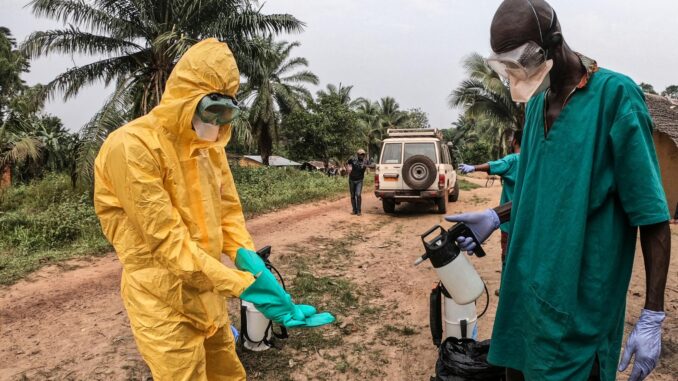
In recent years, vaccines were successfully developed against the Zaire strain of Ebola, but the Bundibugyo variant remains without reliable vaccine protection. That means the response will depend largely on isolation measures, contact tracing, protective equipment, and rapid intervention.
For many experts, that may not be enough in a region where hospitals often lack electricity, medicines, and even secure roads.
The first known patient was reportedly a nurse who arrived at a medical facility in Bunia on April 24 with symptoms consistent with Ebola infection, including fever, hemorrhaging, and vomiting. Since then, several suspected cases have emerged in surrounding areas.
The health zones of Mongbwalu and Rwampara are currently the hardest hit. International health organizations fear the virus could spread further through mining routes and regional trade networks.
The WHO has already announced the emergency airlift of five tons of medical supplies, including protective equipment and emergency response kits. But the crisis goes far beyond the immediate outbreak itself.
Because Ebola does not only attack the human body. It destroys local economies, isolates communities, spreads fear, and overwhelms already fragile healthcare systems. Every outbreak leaves behind orphaned children, abandoned villages, hunger, and deep mistrust toward institutions.
Since its discovery in 1976, Ebola has killed more than 15,000 people across Africa. The deadliest recent outbreak in Congo, between 2018 and 2020, claimed nearly 2,300 lives.
And while much of the world remains distracted by wars, energy crises, and geopolitical tensions, central Africa is once again fighting a brutal battle against an invisible enemy.
Health officials are warning that if the virus spreads beyond Ituri into major urban centers or high-mobility international corridors, the risk of a wider regional health emergency could become very real.
Ebola is back. And once again, Congo finds itself standing on the front line of a deadly global threat.