
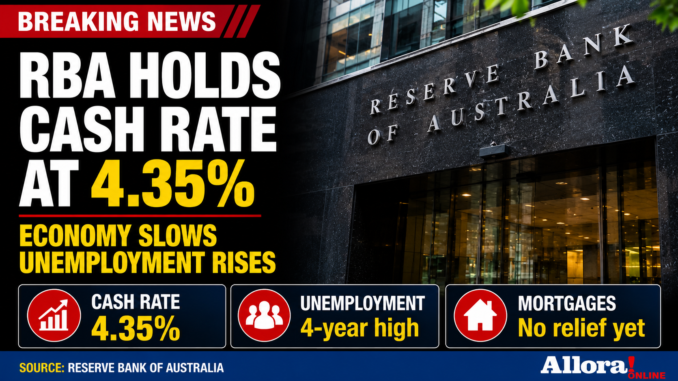
The Reserve Bank of Australia has left the official cash rate unchanged at 4.35 per cent, opting for caution as economic growth slows and unemployment reaches its highest level in four years.
The widely anticipated decision, announced on Tuesday, offers little immediate relief for mortgage holders who have already absorbed three consecutive interest rate increases during 2026.
While inflation remains a concern, the latest economic indicators suggest the Australian economy is losing momentum. Consumer spending has softened, business activity has slowed and unemployment has continued to edge higher, prompting the central bank to pause further tightening.
For millions of Australians with home loans, the decision means mortgage repayments will remain at elevated levels for the foreseeable future.
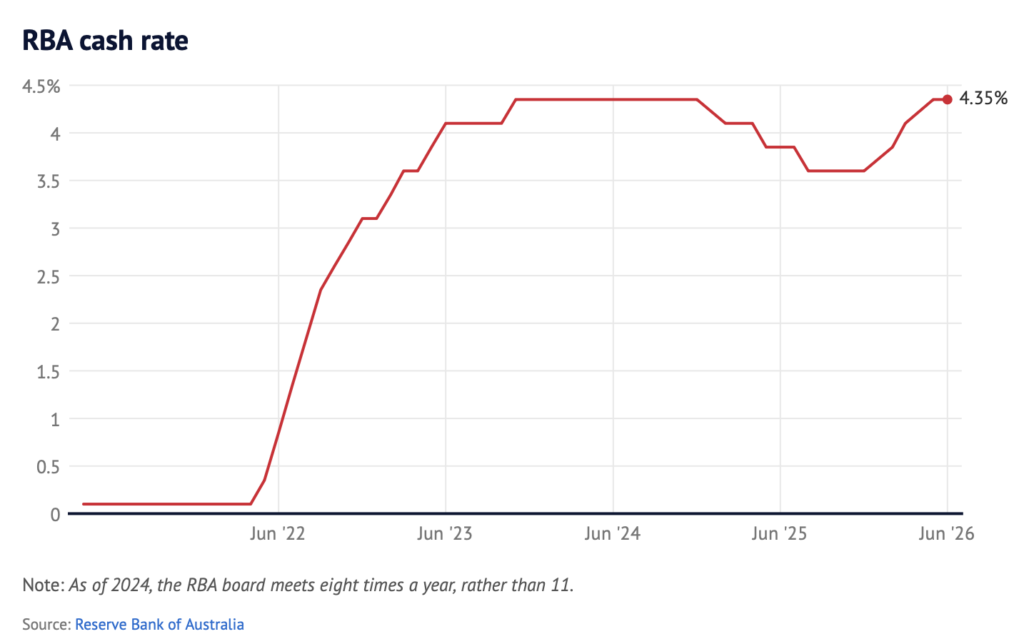
The RBA’s board acknowledged that higher borrowing costs are continuing to weigh on households, particularly as families grapple with rising living expenses and slower wage growth.
Economists had largely expected the central bank to keep rates unchanged, arguing that previous rate rises are still working their way through the economy.
The latest labour market figures have also added to the case for caution. Australia’s unemployment rate has now climbed to its highest level since 2022, raising concerns that further rate increases could place additional pressure on employment and economic activity.
Financial markets are increasingly debating whether the next move by the Reserve Bank will be another increase or the beginning of a rate-cutting cycle if economic conditions continue to weaken.
For now, however, the RBA appears determined to balance the fight against inflation with the growing risk of an economic slowdown.
The decision is likely to be welcomed by homeowners and businesses seeking greater certainty after months of interest rate volatility, although many borrowers remain hopeful that rates may begin to fall in 2027 if inflation continues to moderate.
Attention will now turn to upcoming inflation, employment and retail spending data, which are expected to play a crucial role in determining the Reserve Bank’s next move.
Source: Reserve Bank of Australia (RBA).


Be the first to comment