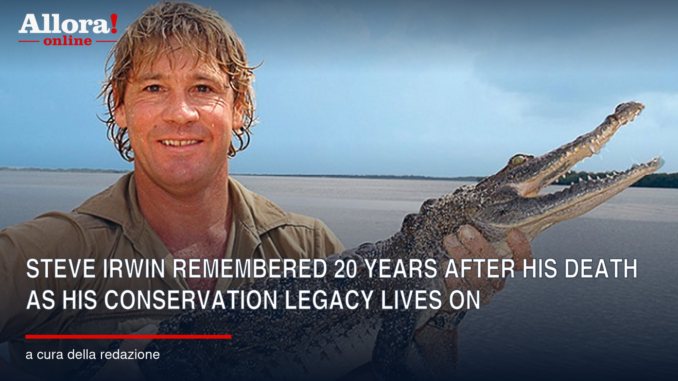
Twenty years after Steve Irwin’s death, the Crocodile Hunter remains one of Australia’s most recognisable conservation figures. Irwin died on September 4, 2006, after being struck in the chest by a stingray barb while filming off Queensland. Two decades later, his legacy continues through Australia Zoo, wildlife research programs and the work of his family.
Twenty years on, Steve Irwin remains deeply embedded in Australia’s cultural memory.
The wildlife conservationist and television personality known around the world as The Crocodile Hunter died on September 4, 2006, while filming at Batt Reef, off Port Douglas in Far North Queensland. He was 44.
Irwin was snorkelling in shallow water when a stingray struck him with its barb, piercing his heart. The crew attempted to save him, but his injuries were fatal.
News of his death spread rapidly across Australia and around the world.
From zoo worker to international television star
Long before global fame, Irwin was working with reptiles and crocodiles at his family’s wildlife park in Queensland.
Wes Mannion, who later became one of his closest friends and colleagues, first met Irwin in the mid-1980s.
Mannion was 14 when he saw Irwin handling an alligator and immediately became fascinated by him. The relationship eventually grew into a close friendship and professional partnership.
Mannion has described Irwin as a brother, best friend, mentor and boss all at once.
The television breakthrough came through producer and director John Stainton.
Stainton first encountered Irwin during a commercial shoot and later received some home videos recorded around the zoo.
He has recalled sitting down to watch one tape around midnight and remaining in front of the television until 3am, captivated by Irwin’s presence.
That encounter helped lead to The Crocodile Hunter, the television series that turned Irwin into an international celebrity.
A different kind of wildlife television
Irwin’s success was not based simply on crocodiles or dangerous animals.
He developed a highly distinctive style of wildlife communication — direct, physical, energetic and instantly recognisable.
Editor Bob Blasdall, who worked on all five seasons of the series as well as Irwin’s documentaries, has described the extraordinary ability Irwin had to pull viewers into the action.
Irwin did not present wildlife from a distance. He ran through bushland, entered rivers, handled snakes and worked at close range with crocodiles.
Behind the energy, however, there was a consistent message: understanding animals was essential to protecting them.
Television gave him a platform to take that message to an audience few conservationists had ever reached.
September 4, 2006
In 2006, Irwin was working on the documentary Ocean’s Deadliest.
At about 11am on September 4, while filming in shallow waters at Batt Reef, the fatal encounter occurred.
It is believed the stingray may have reacted defensively after mistaking Irwin’s shadow for that of a predator.
John Stainton was on the boat that day.
He later had the devastating responsibility of telling Irwin’s wife, Terri Irwin, that her husband had died.
A memorial watched around the world
The scale of public grief became clear in the days that followed.
Thousands of people travelled to Australia Zoo to leave flowers, messages and tributes.
On September 20, 2006, a memorial service was held at the zoo’s Crocoseum.
An estimated 300 million television viewers watched around the world.
Irwin’s father, Bob, told those gathered that animals had lost one of their greatest friends.
His eight-year-old daughter Bindi Irwin also addressed the crowd.
“My daddy was my hero,” she said, adding that she wanted his passion for endangered wildlife to continue.
Twenty years later, that commitment remains central to the Irwin family’s public life.
Terri, Bindi and Robert continue the work
Australia Zoo now attracts about 700,000 visitors a year.
Terri Irwin and children Bindi and Robert remain closely involved in the zoo and its conservation activities.
The Steve Irwin Wildlife Reserve protects about 180,000 hectares of habitat across Queensland.
The family also continues research involving saltwater crocodiles in Far North Queensland, extending work that Steve Irwin himself helped establish.
Bindi and Robert have become major public figures in their own right, particularly in Australia and the United States.
Robert recently hosted the Logie Awards and continues to work with reptiles and other animals in a style that inevitably recalls his father.
The memory of a friend
Wes Mannion stepped down as director of Australia Zoo in 2020 after helping guide Bindi and Robert in the years following their father’s death.
He also passed on some of the skills Irwin had taught him, including working with crocodiles and snakes.
Mannion has said he has no doubt Steve would be proud of the adults his children have become.
That is perhaps where Irwin’s legacy is most visible today.
He was a television star, but his influence did not end with television. Australia Zoo continues to operate, wildlife research continues and the family has kept conservation at the centre of its work.
The Crocodile Hunter’s voice fell silent on September 4, 2006. Twenty years later, the mission behind that voice is still continuing.