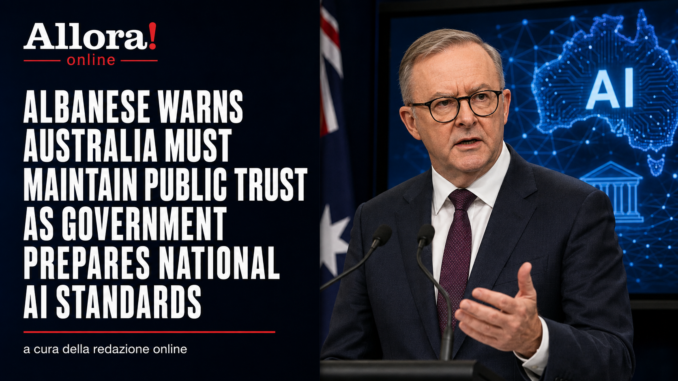
Prime Minister Anthony Albanese is preparing a new national framework for artificial intelligence and data centres, including minimum requirements on energy and water use, copyright, security and training. He has warned that maintaining Australia’s “social licence” will be crucial if the country wants to attract major investment in AI infrastructure without pushing up household bills or putting pressure on water supplies.
Australia wants to position itself as a major regional hub for artificial intelligence, but the federal government says that growth cannot come at any cost.
Anthony Albanese is expected to outline the government’s approach first at the Business Council of Australia annual dinner and then at a meeting of National Cabinet, where state and territory leaders will discuss a new national standard for AI.
The aim is to avoid a patchwork of different rules across Australia.
A national framework for artificial intelligence
The federal government is expected to propose minimum obligations for large data centres that support AI systems.
Key areas are expected to include:
- energy use;
- water consumption;
- cybersecurity;
- copyright protections;
- safety standards;
- training and accountability;
- appropriate locations for new data centres.
Albanese is also expected to argue for a more coordinated national approach to AI policy, overseen through a central office within the federal government.
The broader ambition is to give Australia a single national framework capable of supporting both investment and regulation as AI develops rapidly.
“Energy bills must not rise”
One of the biggest challenges is the infrastructure required to power advanced AI.
Large data centres consume significant amounts of electricity and can also require substantial water supplies for cooling.
That is why Albanese is placing strong emphasis on what he calls “social licence” — maintaining public confidence and community acceptance.
The Prime Minister is expected to warn that Australia must ensure energy bills do not rise because of AI investment, water security is protected and data centres are built in suitable locations.
These concerns are likely to become increasingly important as new facilities compete with households and businesses for electricity, grid capacity and water.
Australia wants to become an Indo-Pacific AI hub
Despite those concerns, the federal government sees a major economic opportunity.
Albanese is expected to argue that Australia can do more to attract frontier AI development, including the training of some of the world’s most advanced AI models.
Hosting large-scale AI training facilities could allow Australia to capture a greater share of the economic value generated by the technology, while also building technical expertise and strategic influence.
The government also sees Australia’s position as a member of the Five Eyes intelligence partnership as a potential advantage for investors looking for secure and trusted infrastructure.
According to Albanese, expanding Australia’s AI capability could strengthen national sovereignty, national security, productivity, science, innovation and resilience.
Business Council warns Australia must improve competitiveness
The AI debate is also linked to a broader argument about Australia’s economic competitiveness.
Business Council of Australia chief executive Bran Black is expected to warn that living standards will continue to fall unless Australia becomes more attractive to global investors.
According to the BCA, Australia ranks only 21st out of 42 countries on its Global Competitive Index.
Black is expected to argue that Australia cannot “tax, regulate or redistribute” its way to higher living standards.
Instead, the BCA says the country needs stronger productivity, more business investment, greater innovation and policies that encourage companies to expand and employ more Australians.
An 18-point investment roadmap
The Business Council has launched an 18-point roadmap aimed at improving Australia’s competitiveness and attracting more international capital.
Its argument is that stronger economic growth would ultimately support higher wages, more housing construction and better services.
AI is a major part of that strategy.
The BCA says artificial intelligence has the potential to lift productivity, create new industries, attract large-scale investment and improve the way Australians work and live.
The challenge: growth without losing public confidence
On one point, government and business appear to agree: artificial intelligence could become one of Australia’s biggest economic opportunities.
The disagreement is likely to centre on how that opportunity should be managed.
Canberra wants to attract investment without shifting the cost onto households through higher electricity bills or additional pressure on water supplies.
Business groups, meanwhile, are warning against excessive regulation and taxation that could discourage investment.
The challenge for Australia will be finding the right balance: building a competitive AI industry that delivers productivity and growth while remaining sustainable, secure and trusted by the public.