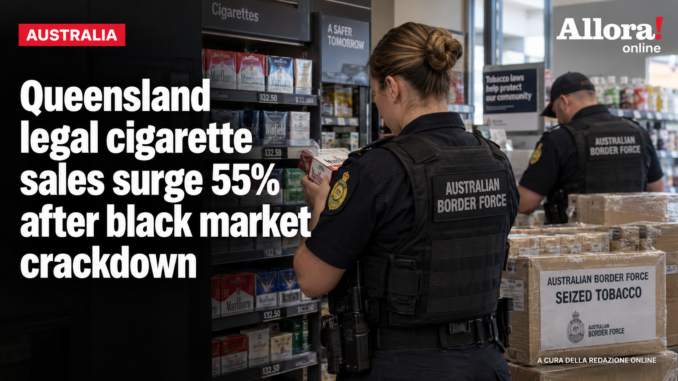
Legal tobacco sales in Queensland jumped 55 per cent in the first month after authorities were given stronger powers to shut down illegal retailers. Sales then remained between 40 and 45 per cent above previous levels for the following six months, while calls to Quitline also increased sharply. The figures are reigniting the national debate over tobacco excise.
Queensland’s intensified crackdown on illegal cigarettes, vapes, nicotine pouches and loose tobacco appears to have produced an immediate shift in the market.
According to new data from major supermarkets and other retailers provided to the Illicit Tobacco and E-cigarette Commissioner, legal cigarette sales increased by 55 per cent in Queensland during the first month after stronger enforcement powers came into effect.
Over the following six months, legal sales remained 40 to 45 per cent higher than previous levels.
During the same period, cigarette sales across the national legal market remained largely unchanged.
STRONGER ENFORCEMENT, MORE LEGAL SALES
Queensland has significantly strengthened its response to the illicit tobacco trade.
New laws allow Queensland Health to close businesses selling illegal tobacco and vaping products for up to 90 days without first obtaining a court order.
Landlords who knowingly lease premises to illicit tobacco or vape operators can also face serious penalties, including fines of up to $161,300 and potentially 12 months in prison.
Since November last year, Queensland Health has issued more than 300 closure orders.
Across Australia, more than 1,000 illicit tobacco stores have now reportedly been shut down.
MILLIONS OF ILLEGAL CIGARETTES SEIZED
A recent 10-day enforcement operation resulted in 148 stores receiving three-month closure orders.
Authorities seized more than:
- 11.8 million cigarettes
- 1.7 tonnes of loose tobacco
- 87,000 vapes
- 4.2 litres of vaping liquid
- 270,000 nicotine pouches
The combined estimated street value of the seized products was approximately $15.7 million.
QUITLINE CALLS MORE THAN DOUBLE
The enforcement campaign may also be having an impact on smoking behaviour.
Calls to Quitline more than doubled during the 10 days following major enforcement operations.
The figures suggest that when access to cheaper illegal cigarettes becomes more difficult, some smokers may not simply return to legal products but may instead consider quitting.
However, the data does not establish a direct cause-and-effect relationship. Other factors may also have contributed to the increase in Quitline contacts.
$100 MILLION BOOST IN TAX REVENUE
The shift back towards the legal tobacco market is also expected to increase government revenue.
Queensland’s crackdown is projected to generate approximately $89 million in additional tobacco excise revenue and another $11 million in GST revenue over two years.
That could cover, and potentially exceed, the cost of the enforcement campaign.
THE POLITICAL BATTLE OVER TOBACCO TAX
The Queensland figures come as Australia continues to debate whether extremely high tobacco taxes are contributing to the growth of the illegal market.
The federal government has rejected calls for a dramatic reduction in tobacco excise, arguing that Queensland’s experience shows strong enforcement can disrupt the black market without making legal cigarettes cheaper.
The Coalition and One Nation have proposed a different approach.
The Coalition has backed an 80 per cent reduction in tobacco excise, while One Nation has proposed a 75 per cent cutcombined with a three-year freeze on indexation.
Supporters argue that narrowing the price gap between legal and illegal cigarettes would reduce the profits available to organised crime.
The federal government argues that substantially lowering tobacco taxes could undermine decades of public health policy aimed at discouraging smoking through higher prices.
NSW AND VICTORIA UNDER PRESSURE
Queensland’s experience could now influence the approach taken by other states.
In New South Wales, Premier Chris Minns has previously questioned whether the current tobacco excise regime remains effective, warning that the illegal market is placing additional pressure on state police.
Victoria has faced particularly serious problems associated with the illicit tobacco trade, including repeated arson attacks and violent disputes linked to organised crime.
The state has since introduced stronger laws allowing authorities to close illegal tobacco retailers.
PUBLIC HEALTH VERSUS ORGANISED CRIME
Australia’s tobacco debate has become about much more than taxation.
On one side is the long-standing public health strategy of maintaining high cigarette prices to discourage smoking.
On the other is growing concern that those prices have helped create a highly profitable black market exploited by organised criminal groups.
The early Queensland figures suggest that aggressive enforcement can push some consumers back into the legal market.
The larger question is whether the Queensland model can be successfully replicated across Australia — and whether enforcement alone will be enough to significantly reduce the illegal tobacco trade over the long term.