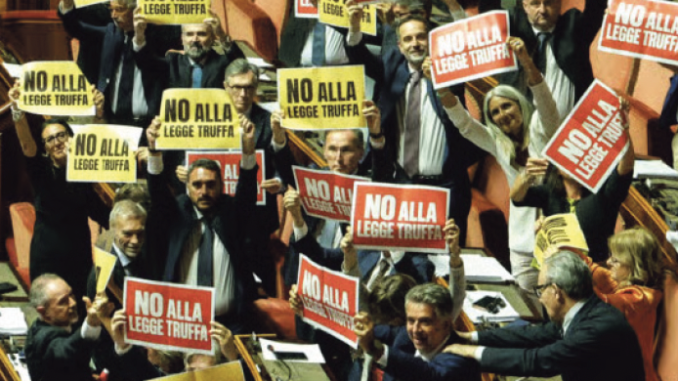
A controversial electoral reform approved by the Italian Senate has drawn criticism from Democratic Party senator Francesco Giacobbe, who warned that the changes could significantly weaken the parliamentary representation of Italians living overseas.
Giacobbe, who represents the Africa, Asia, Oceania and Antarctica division of the Overseas Constituency, said the Senate had rejected all opposition amendments and ignored concerns raised by Italian communities, Comites and the General Council of Italians Abroad (CGIE).
At the centre of the dispute is Article 6 of the reform, which changes the way overseas constituencies are organised. Under the new provisions, the Chamber of Deputies would have two overseas divisions, while the Senate would have a single worldwide constituency.
According to Giacobbe, the change would abolish the separate representation currently provided for North and Central America and for Africa, Asia, Oceania and Antarctica.
“The practical result is the cancellation of parliamentary representation for these immense areas of the world,” Giacobbe said, arguing that representation would instead become concentrated in regions with larger Italian communities, particularly Europe and South America. He also questioned the practicality of creating what he described as a “senator of the world”, responsible for representing Italian communities spread across every continent.
“No parliamentarian will be able to know, reach and maintain a direct relationship with all the Italian communities across the globe,” he said.
The senator argued that geographical distance is not simply an administrative issue. Italian communities overseas have developed through different waves of migration and often face distinct social, economic and cultural circumstances in their countries of residence. A system based on broad territorial divisions, he maintains, allows elected representatives to remain more closely connected to those communities.
Giacobbe argued that the existing system established under the Tremaglia electoral law had sought to balance proportional representation with territorial representation through four separate overseas divisions. The system, he said, recognised the geographical distances involved, the history of Italian migration and the differing circumstances of Italian communities in their countries of residence.
The senator said the Democratic Party had proposed either removing Article 6 from the legislation or delaying its implementation until the second subsequent parliamentary term. Both proposals were rejected.
The legislation will now return to the Chamber of Deputies for further consideration, where Giacobbe said the opposition would continue its campaign against Article 6. He also indicated that further legal avenues could be pursued if the provision becomes law, including seeking constitutional scrutiny. “Italian citizens abroad are not second-class citizens and cannot be deprived of authentic, territorial representation that remains close to their communities,” Giacobbe said.
The dispute places the future structure of overseas parliamentary representation at the centre of the next stage of the electoral reform debate, with particular significance for Italian communities spread across countries and continents far from Italy.