Allora! Online – Redazione
France is facing a major political and public order crisis after a weekend of nationwide protests descended into violence, widespread looting and destruction. Around 1,800 people have been arrested, approximately 1,500 businesses have been damaged, and hundreds of police officers and emergency personnel have been injured. President Emmanuel Macron is preparing to address the nation as anger over the cost of living continues to intensify.
France is struggling to recover from a weekend of violent unrest that has left major cities scarred by fires, vandalism and looting, bringing renewed pressure on President Emmanuel Macron during the final months of his presidency.
Demonstrations against rising living costs, fuel prices and economic hardship drew hundreds of thousands of people into the streets, but some gatherings deteriorated into serious confrontations between protesters and security forces.
The violence affected Paris, Marseille, Lyon, Bordeaux, Nice, Strasbourg and several other cities, leaving damaged businesses, burned vehicles and significant disruption to public life.
French Interior Minister Laurent Nunez confirmed approximately 1,800 arrests nationwide, as police launched investigations to identify those responsible for attacks on property and public infrastructure.
The damage has been estimated at hundreds of millions of euros, raising concerns about the economic consequences for businesses already struggling with inflation and rising operating costs.
Paris: hundreds detained as shops are looted
The French capital experienced some of the most serious disorder.
Police reported that 557 people were being held in custody following what officials described as an exceptional number of arrests.
Streets in central Paris were left littered with shattered glass, burned barricades, damaged bicycles and the remains of vehicles set alight during the demonstrations.
Shopfronts were smashed and retailers targeted by groups of looters who moved through commercial districts as confrontations continued nearby.
Residents described scenes of fear and confusion as police deployed tear gas and riot-control equipment to disperse violent groups.
Mehmet Ozeden, a 78-year-old resident of central Paris, compared the destruction to the aftermath of a war.
Other residents reported watching groups of young people enter shops and steal goods while police struggled to contain multiple disturbances.
Paris deputy mayor Lamia El Aaraje described the level of violence as extraordinary, highlighting the scale of the destruction witnessed across the capital.
Historic Limoges town hall destroyed by fire
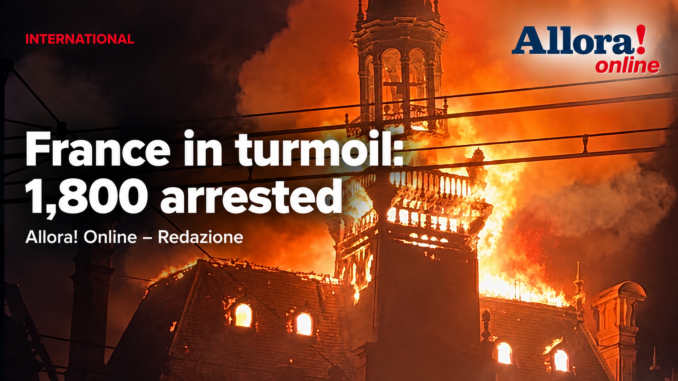
One of the most devastating incidents occurred in Limoges, where the city’s historic 19th-century town hall was engulfed by flames.
The fire caused extensive destruction to the landmark building, a major symbol of the city’s architectural and civic heritage.
Local prefect Maurice Barate said the blaze had been deliberately started during the unrest.
Firefighters worked through the night before bringing the fire under control early on Sunday.
The destruction has generated particular concern because of the historical significance of the building and the potential cost of restoring or replacing damaged structures.
The loss also illustrates how protests focused on economic grievances can have consequences extending far beyond temporary disruption.
Lyon, Marseille and other cities affected
Violence was not confined to Paris.
In Lyon, protesters and riot police clashed as several buildings and commercial premises were attacked.
A tourist office in the city centre was set on fire, adding to the destruction of local infrastructure.
Lyon mayor Grégory Doucet condemned the disorder, describing the hours of chaos as deeply disturbing.
Marseille, Bordeaux, Nice and Strasbourg also experienced looting, property damage and confrontations between groups of protesters and security forces.
Across the country, approximately 1,500 businesses were reportedly affected.
Retail industry representatives estimate that the combined losses could reach hundreds of millions of euros.
These costs include physical damage, stolen merchandise, emergency repairs, interrupted trading and additional security expenses.
Around 500 police and emergency workers injured
The human consequences of the unrest have also been significant.
Interior Minister Nunez said approximately 500 police officers, firefighters and paramedics were injured during the weekend’s disturbances.
Emergency workers faced difficult conditions as they attempted to control fires, assist injured people and maintain access to affected areas.
In Saint-Étienne, a 17-year-old boy reportedly lost his right hand after being struck by a crowd-control grenade.
The incident has raised further questions about the use of force during demonstrations and the risks associated with certain riot-control weapons.
Authorities have also reported one death during the main Paris march, although officials said it was related to a medical condition rather than protest violence.
Investigations are continuing into the circumstances of the most serious incidents.
More than half a million people joined the demonstrations
Despite the disorder, the majority of participants were involved in protests focused on economic and social concerns.
According to the French Interior Ministry, approximately 550,000 people attended demonstrations across the country.
The CGT trade union provided a higher estimate of 800,000 participants.
The difference reflects the competing crowd estimates frequently seen during major French demonstrations.
The protests were organised around rising living costs, increased fuel prices and demands for greater government action to support households.
The demonstrations also attracted students, teachers, parents and other groups concerned about school conditions and public services.
The mobilisation followed weeks of student protests, some of which had already experienced violent incidents.
Yellow Vests return amid growing economic frustration
The unrest has brought renewed attention to France’s Yellow Vest movement, which emerged in 2018 in opposition to proposed fuel-tax increases and broader concerns about purchasing power.
Eight years after its original mobilisation, the movement has again become associated with demonstrations over the economic pressures facing French households.
The latest protests, promoted as a joint mobilisation involving Yellow Vests and young people, reflect concerns about inflation and the rising cost of essential goods.
Fuel prices have become particularly sensitive as the war in the Middle East disrupts international energy markets.
Higher transport and production costs have contributed to financial pressure on businesses and consumers across Europe.
For many demonstrators, the protests represent frustration with declining purchasing power and the perceived inadequacy of government responses.
However, the violence carried out by some groups has shifted much of the national debate from economic policy towards public security.
Macron faces mounting political pressure
The unrest arrives at a particularly sensitive moment for President Emmanuel Macron.
With presidential elections expected in approximately six months, France is entering a period of heightened political competition.
Macron was expected to address the nation on Sunday evening after consultations with senior government ministers.
His response will be closely watched by political parties, trade unions, business organisations and the wider public.
The government faces the challenge of restoring order while also responding to the underlying economic grievances that brought large numbers of people onto the streets.
The demonstrations have also intensified debate about the effectiveness of public order measures and the responsibilities of political leaders during periods of social tension.
Political parties exchange accusations
The disorder has prompted sharp exchanges across the French political spectrum.
Government representatives and far-right leader Marine Le Pen have blamed violent ultra-left groups for some of the destruction.
Far-left politician Jean-Luc Mélenchon has instead accused the authorities of contributing to the escalation of tensions through their handling of the demonstrations.
Paris deputy mayor Lamia El Aaraje criticised Le Pen’s party, arguing that it was seeking political advantage from the unrest.
These competing interpretations reflect broader divisions over the causes of the violence and the appropriate response.
Analysts have also distinguished between the overwhelmingly peaceful participants and smaller groups responsible for attacks on police, vandalism and looting.
Political analyst Mujtaba Rahman of Eurasia Group argued that much of the violence was associated with fringe extremist groups and opportunistic criminal activity.
Such assessments underline the importance of separating the motivations of peaceful demonstrators from the actions of individuals involved in criminal offences.
Tourism and retail businesses count the cost
France’s tourism industry is among the sectors exposed to the consequences of prolonged unrest.
During Saturday’s demonstrations, tourists in central Paris were seen moving rapidly through streets affected by tear gas and police operations.
Some visitors described feeling frightened by the disorder and saddened by the destruction of historic buildings and commercial areas.
For hotels, restaurants, shops and tourism operators, repeated protests can create uncertainty over access, staffing, bookings and business continuity.
The estimated damage to 1,500 businesses also creates additional pressure for insurers and public authorities involved in recovery and reconstruction.
In cities such as Paris and Lyon, the restoration of public spaces and damaged commercial premises will require significant resources.
The financial consequences may continue long after the demonstrations have ended.
France faces a difficult recovery
The coming days will be crucial for restoring public confidence and determining whether further demonstrations take place.
Police investigations are continuing, with authorities seeking to identify those responsible for looting, arson and attacks against emergency personnel.
Meanwhile, businesses face extensive repairs and residents are attempting to return to normal routines.
The central challenge for the French government is to address two separate but interconnected problems: the public order crisis created by violent groups and the economic dissatisfaction expressed by hundreds of thousands of peaceful demonstrators.
The distinction will be essential in shaping the political response.
With approximately 1,800 arrests, hundreds of injured emergency workers and damage estimated in the hundreds of millions of euros, France is confronting one of the most serious episodes of civil unrest reported in recent years.
As President Macron prepares to address the nation, the immediate priority is restoring security. The longer-term challenge will be responding to the economic frustration behind the demonstrations without allowing violence to define the national debate.