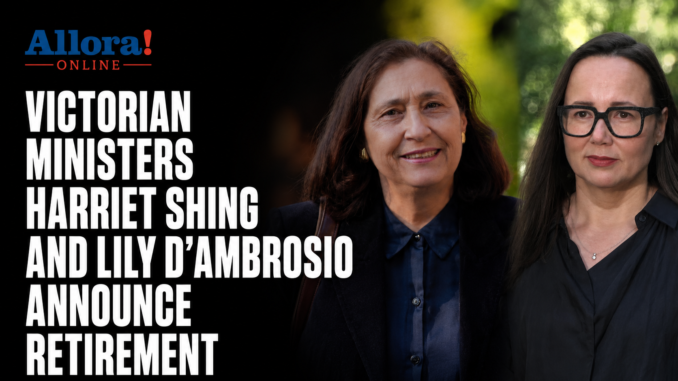
The two senior Labor figures will not contest the November election and have stepped down from cabinet, leaving new Premier Ben Carroll with three vacancies to fill as internal factional negotiations intensify
The Victorian Labor government has lost two more senior figures just months before the state election in November.
Health Minister Harriet Shing and veteran minister Lily D’Ambrosio have announced they will not seek re-election and will step down from cabinet, adding to the upheaval that followed Jacinta Allan’s resignation as premier.
Their departures come as newly installed Labor leader Ben Carroll attempts to rebuild the government, unite the party and present voters with a renewed team capable of confronting the Liberal Party and One Nation.
With Shing and D’Ambrosio leaving, Carroll must now fill three cabinet vacancies associated with Labor’s Left faction.
Harriet Shing Leaves After 12 Years
Shing, first elected to parliament in 2014, informed Carroll that she would not contest the November election.
A senior minister and close ally of Jacinta Allan, Shing said she was proud of Labor’s achievements in government but believed it was time to pass the opportunities and responsibilities of public office to someone else.
She congratulated Carroll on becoming premier and called on cabinet, caucus and the wider labour movement to support him.
“He deserves the full support, solidarity and respect of the cabinet, the caucus and our entire labour movement as he takes the government forward,” she said.
Shing also framed the coming election as a crucial contest against both the Liberal Party and One Nation.
Her retirement has an electoral dimension. She held the second position on Labor’s upper-house ticket at the 2022 election and was considered vulnerable to losing her seat if the party suffered a significant swing in November.
D’Ambrosio Retires After 24 Years
The departure of Lily D’Ambrosio is even more significant.
She is retiring after 24 years as the member for Mill Park and after serving in government for 20 of those years.
D’Ambrosio was the final minister remaining from Daniel Andrews’ first cabinet in 2014. Along with Jacinta Allan, she was also one of the last Labor MPs still serving from the Bracks and Brumby government era.
Reflecting on her career, D’Ambrosio identified Victoria’s transition towards renewable energy as her proudest achievement.
When Labor returned to office in 2014, renewable sources provided less than 11 per cent of the state’s electricity. That figure has since increased to about 45 per cent.
“Where Victoria has gone, the rest of the country has followed,” she said.
A Message to Women and Girls
D’Ambrosio also used her retirement announcement to encourage women and girls to pursue careers in politics and public service.
“I hope my life in public service shows all girls what is possible for them, no matter their faith, what they look like or the way they speak,” she said.
She urged women to back themselves and support one another.
D’Ambrosio also expressed hope that Labor would select a local woman to replace her as the candidate for Mill Park.
Her departure removes not only one of the government’s most experienced ministers but also a central figure in Victoria’s energy and climate policy.
Three Cabinet Positions to Fill
Carroll already had one cabinet vacancy to fill following Allan’s resignation, with that position reportedly promised to Tim Richardson.
The departures of Shing and D’Ambrosio create two more openings.
All three vacancies are linked to Labor’s Left faction, making the redistribution of portfolios and cabinet positions particularly sensitive.
Backbenchers have already begun lobbying for promotion, while negotiations continue over factional balance, gender representation and regional interests.
Carroll must decide whether to promote experienced MPs to provide continuity or elevate a new generation and present the reshuffle as evidence of a genuine political reset.
Tensions Over Upper-House Positions
Shing’s retirement also affects the continuing dispute over Labor’s upper-house ticket.
There has been persistent internal debate about the placement of candidates and the possibility that a major swing against the government could prevent candidates in second position from being elected.
Some Labor figures have argued that abolishing group voting tickets could improve the prospects of candidates placed second on the ballot.
Others fear that changing electoral arrangements so close to the election could create unpredictable consequences.
Shing’s decision avoids a potentially damaging internal battle over her position, but leaves another vacancy requiring negotiation.
The End of a Political Era
The resignations of Allan and the retirements of Shing and D’Ambrosio mark the end of a significant period in Victorian Labor politics.
Within days, the party has lost three women who held major roles in government and in the administration of the state.
For Carroll, the reshuffle presents both a risk and an opportunity.
The risk is that Labor appears to be losing senior figures and entering the election with a government in retreat.
The opportunity is to build a new team, distance his leadership from unpopular aspects of the long era that began under Daniel Andrews and demonstrate that the change goes beyond replacing the premier.
A Difficult Election Campaign Ahead
The opposition is likely to portray the retirements as evidence of an exhausted government nearing the end of its political cycle.
Labor will argue that the departures represent a natural generational transition after many years of public service.
Carroll’s challenge will be to convince voters that the changes involve new priorities and a different style of government, not merely a reshuffling of positions.
He must now rebuild cabinet, manage factional tensions, select new candidates and prepare for a difficult election campaign within a matter of months.
D’Ambrosio’s retirement symbolically closes the chapter opened by Victoria’s earlier Labor governments. Shing’s departure further weakens the group closely associated with Jacinta Allan.
Victorian Labor therefore enters the November election with a new premier, a cabinet to reconstruct and a central question to answer: is this the beginning of a genuine renewal, or the final reshuffle before the end of a long political era?